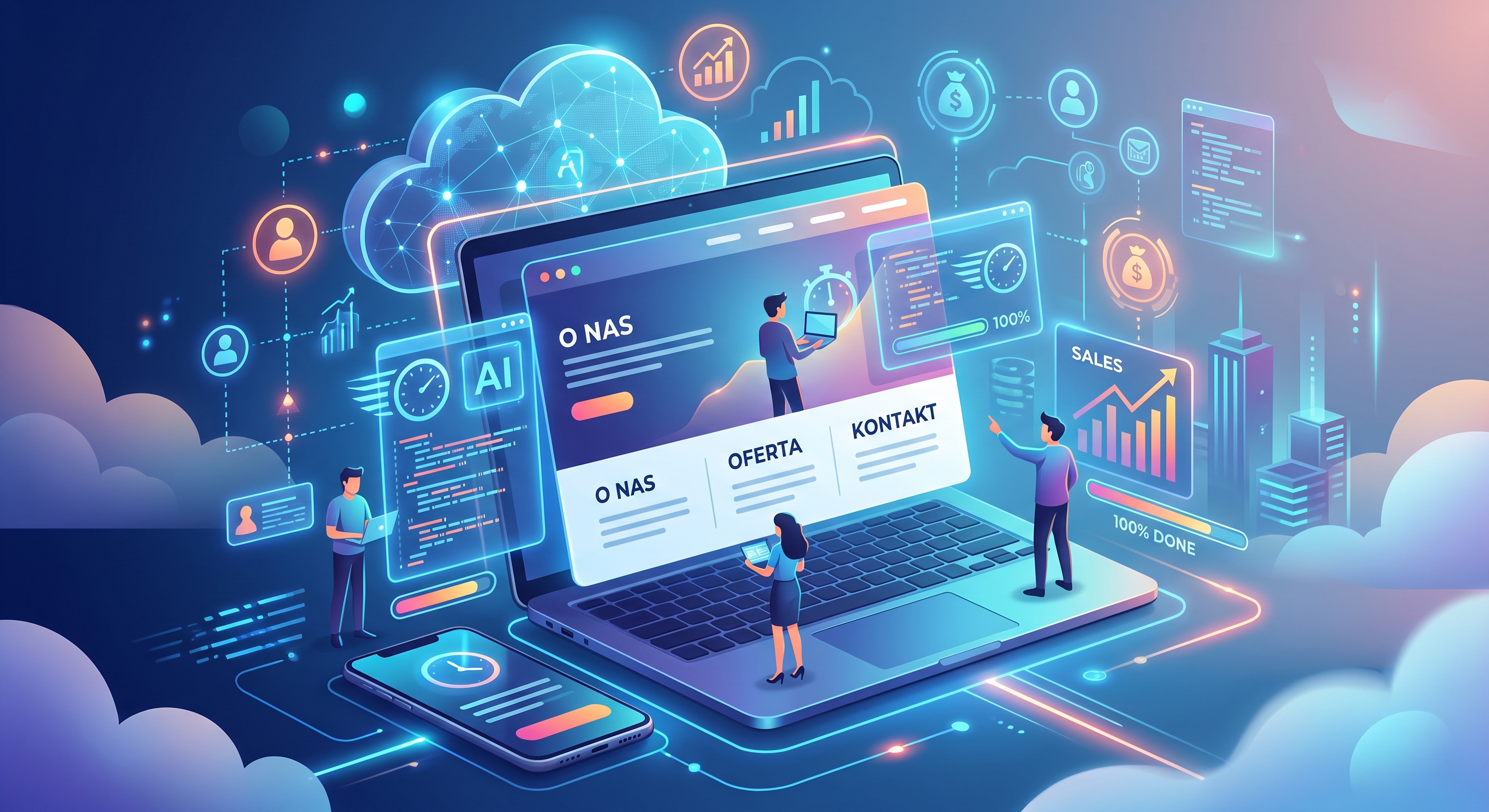
Business Card Websites in 2026: The AI-Powered Blueprint for Experts
A business card website in 2026 is no longer just static HTML. Discover how to leverage AI website generators to rapidly build credibility while saving weeks of work.
According to the latest Q3 2026 analytical reports from Gartner, generative AI adoption across small businesses has ceased being an experiment and has solidified into an everyday operational standard. Looking back after 29 years working across the IT industry, the evolution from hand-crafting tables in raw HTML to today’s toolsets feels like stepping off a stagecoach directly onto a high-speed maglev train. Platforms like Framer, Lovable, and Hostinger AI are democratizing web creation, enabling anyone to publish a fully functional business card website in just a few hours. Yet, this tectonic shift brings an uncompromising truth: as technological barriers collapse, merely being visible online no longer sells. The winners are those who harness AI as a leverage multiplier for sound strategy and genuine human expertise.
What key numbers explain the shift from manual coding to AI generation?
Market data from 2026 paints an unmistakable, sobering picture for traditional web development workflows on entry-level sites. Over 84% of freelancers and small businesses now launch their online footprint entirely through natural-language prompts and modern no-code platforms. The global AI Web Design software market expanded past $18 billion USD this year, surging from barely $4 billion at the close of 2023. The most striking metric, however, is Time-to-Market. While a decade ago the cycle of briefing, wireframing, front-end development, and cross-browser QA required a minimum of 4 weeks, today drafting, polishing, and deploying a responsive landing page takes between 2 and 6 hours end-to-end.
What is the real cost and time comparison between workflows?
When planning a deployment, your most valuable assets are operational hours and allocated capital. Juxtaposing the legacy agency model with contemporary AI workflows illustrates a massive performance divide.
| Criterion | Traditional Software House / Agency | Modern AI Builder (e.g., Framer, Lovable) |
|---|---|---|
| Launch Time (MVP) | 3 – 6 weeks | 2 – 4 hours |
| Initial Setup Cost | $1,000 – $4,000 (4,000 – 15,000 PLN) | $0 (within standard tool subscription) |
| Barrier to Entry | Strong HTML/CSS/JS background required | Natural language (conversational prompting) |
| Content Updates | Developer retainers or clunky legacy CMS | Real-time visual editing with AI writing co-pilots |
| Performance & Optimization | Requires manual code minification and audits | Automated tree-shaking and next-gen WebP/AVIF compression |
What exactly do you get “out of the box” when generating a site?
When you delegate the creation of a business website to modern algorithms in 2026, you are no longer handed fragile, generic templates reminiscent of the early 2000s. You receive a structured, production-ready foundation:
- Cascading Layout & UX Architecture: The AI automatically applies established UI/UX conventions, calibrating white space and generating logical sections—Hero, Value Proposition, Services, About Us, and Contact—while adhering to cohesive design tokens.
- Mobile-First Responsiveness: You don’t have to worry about mobile displays after the fact. The engine provisions clean CSS Grid and Flexbox structures natively, delivering seamless ergonomics across every screen resolution.
- Foundational SEO: You get clean H1/H2/H3 semantic heading hierarchies, automated next-gen image compression, descriptive
alttags, and pre-configured XML sitemaps out of the box. - Draft Copywriting: Guided by your prompt, the model composes cohesive service descriptions and benefit-driven headlines, instantly eliminating the friction of the “blank page syndrome.”
How did AI impact a highly niche website?
A prime example of this workflow in practice was the August audit and overhaul of a community hub for a passionate niche—the QWKAK Cardboard Scale Modelers Club. The previous iteration of the site, running on decade-old legacy code, was cluttered, non-responsive, and intimidating for younger hobbyists interested in assembling complex paper scale models.
Using an AI-assisted design tool, the team crafted a prompt capturing the club’s specific aesthetic: technical precision mirroring fighter jet blueprints, the necessity of rich, high-resolution detail galleries, and lightning-fast loading speeds. The engine generated a clean, grid-based layout highlighting the intricate paper textures. Total development time plummeted from an estimated 6 days of manual gallery coding down to 4 hours of content staging and asset curation. The result? The bounce rate dropped by 45%, and the club saw incoming membership inquiries double within the first month. That is the leverage multiplier in action—freeing up time for what truly counts: building the models.
How much does a business card website actually cost in 2026?
Financial realities in 2026 leave no room for waste. Every dollar spent on bloated engineering hours is capital you cannot recover. The breakdown below details realistic average costs for a business card website:
| Implementation Path | One-time Setup Cost | Annual Maintenance (Hosting + Domain / SaaS) | Full Server Control |
|---|---|---|---|
| Traditional Freelancer / Agency | $600 – $2,000 (2,500 – 8,000 PLN) | $80 – $150 (300 – 600 PLN) | High (Own hosting / FTP / cPanel) |
| AI SaaS Platform (e.g., Framer) | $0 (hands-on builder work) | $180 – $380 (700 – 1,500 PLN pro tier) | Low (Vendor lock-in) |
| AI-Generated Code on Custom Server | $0 – $50 (token usage) | $60 – $100 (250 – 400 PLN) | Very High (Full source code ownership) |
Who gains the ultimate leverage using these workflows?
No-code and AI-driven deployment pipelines provide the greatest advantage in environments that reward swift market validation:
- Technical Freelancers & Advisors: Solopreneurs and consultants building automations and MVPs for clients gain a polished portfolio that reflects their capability without wasting billable days wrestling with CSS.
- Startup Founders (MVP Creators): When you need to validate market demand before architecting complex backend logic, an engaging landing page with waitlist capture can be launched over an espresso.
- Local Service Businesses: Plumbers, legal practices, boutique accountants—industries where prospective clients simply seek quick proof of competence and a phone number, rather than elaborate enterprise portals.
When does AI-generated code and design completely fail?
Despite undeniable advances, it is crucial to remain clear-eyed about where generative tooling reaches its ceiling. AI hits a wall the moment custom, high-stakes business logic takes center stage. If your simple business card is intended to scale into an intricate application orchestrating autonomous agents—via architectures like OpenClaw or Paperclip AI—a frontend generated in a site builder will remain merely a facade.
Generative builders also struggle with deep ERP integrations and heavy legacy databases that enterprise architects navigate daily. Furthermore, proprietary SaaS ecosystems risk vendor lock-in, complicating future migrations of hard-won SEO equity when your venture outgrows the platform and demands complete data sovereignty.
Publishing a solid digital business card in 2026 is faster, more accessible, and more cost-effective than ever before. But remember: an algorithm can write the markup, align your UI cards, and streamline responsive breakpoints, but it cannot forge your reputation. Solid metrics, real-world case studies, authentic perspectives, and verified client outcomes are what ultimately prompt a visitor to reach out. Begin with a sharp project brief and an honest audit of your offering. Treat AI as a tireless assistant, not your creative director.
Whenever you set out to systematize and automate your processes, smart AI orchestration yields the highest returns—turning technical friction into focused, scalable business momentum.